
a little help
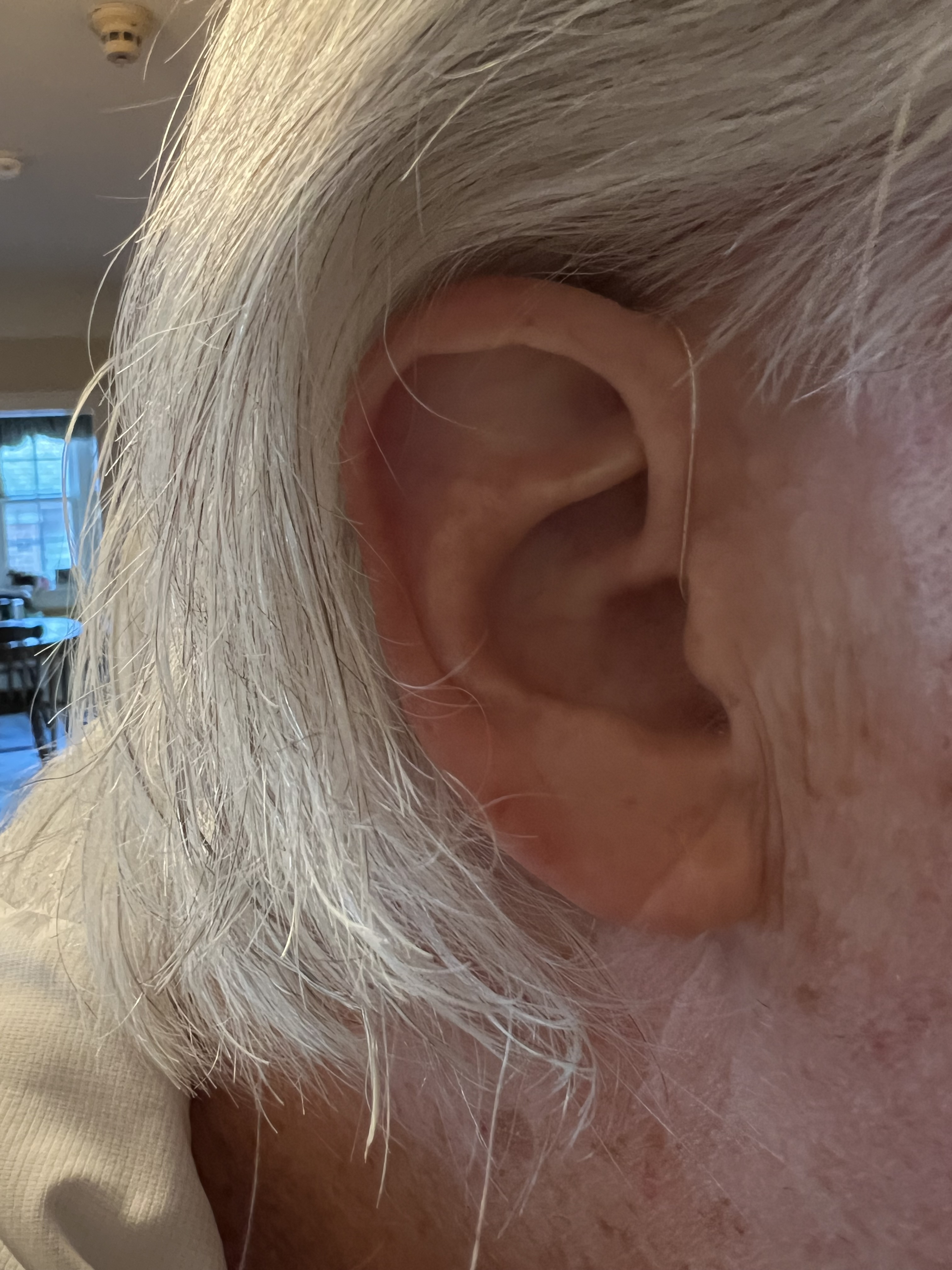
can you see it?
I blame the drummers.
For about forty-five years now, I’ve stood in front of rock-and-roll drummers on stages. Maybe a thousand times, maybe a bit more. If the standard drum riser is about two feet high, and the standard crash cymbal stand holds its payload at about three feet above the baseline, then those cymbals have been at basically my own ears’ level. It seems to me the impulse wave travels more or less horizontally from the point of impact. So if there were a thousand gigs, does that mean there were a hundred thousand metallic explosions just a few feet away from and directly into my ear holes? A million?1
It’s been clear for a few years now that I have a problem. At first it manifested the way these things usually do, with difficulty picking voices out from noisy backgrounds, especially certain kinds of female voices, whatever the opposite of nasal is. I’m not sure “breathy” is the right word, maybe something like “soft,” though I mean it more in terms of timbre than volume.2 There were other, more indirect signs, too. Can’t tell you how many times someone else in the family would use one of the cars after I did and comment about how loud the stereo was. I do tend to listen at high levels, not because I can’t hear it, but because I can’t hear it well. I was missing detail and clarity, the sort of differentiating input that comes in the higher end of the frequency spectrum.
Lately, it had gotten to the point where people could be talking to me in a quiet house, and I wasn’t aware of it. Not like I was stone deaf and hearing nothing at all, but in a way that the information coming at me didn’t register in my brain that it might be directed at me.
It was time to visit the audiologist. I got a recommendation for a good local one from my primary care doctor at my last checkup and went to see her last month. The basic hearing test you remember from grammar school, with the bulky headphones and you signalling to the tester when you hear tones, hasn’t changed all that much. I was in a soundproof booth, which was weird as hell. But besides that, there’s more to it now, including a test where you have to pick a sentence out of increasing levels of background noise (I failed this part miserably) and some other voodoo where they somehow ascertain whether the neurological aspect of your hearing is working well, separate from the physical aspect. Turns out that if you stop hearing clearly for long enough, your brain can sort of “forget” how to hear, even when the signals are amplified somehow. Fortunately I passed that part of the test. It isn’t too late.
The diagnosis was moderate hearing loss, not yet severe. The audiologist’s strong recommendation was to treat it with hearing aids now, rather than wait for the inevitable progression. It’s about that neurological part of the equation, that forgetting how to hear part, and I wanted to get ahead of that. The next steps involved her programming the digital signal processing chips inside these tiny marvels to precisely counter the curve of my hearing loss that she’d previously measured. They come with an app, and I can adjust the presets and volume there. They also integrate seamlessly as a Bluetooth headset would, so I can listen to music on my phone, take calls, etc.
They’re lightweight and comfortable. Other than being able to hear more clearly, I don’t even remember I’m wearing them. And, as the picture up top shows, there’s really no way anyone else would notice them unless I mention it. The microphone and processing part lives above my ear, concealed by my hair, and the speaker wire that extends into my ear is pretty much the same color and texture as my hair. Never thought I’d be grateful for that mess.
They’re also insanely expensive, and here in the Land Of The Free® where we have the Greatest Healthcare System In The World™, not one dollar of them are covered. The FSA tax break is the best you can do, but I didn’t think ahead to sock that much away this year. It’s truly a privilege that I’m able to treat this deficiency in the sensory perception that’s probably most important to my sense of self. Being able to hear what I am most likely to create is kind of the whole point of the exercise. It’s beyond infuriating that the “insurance” industry doesn’t really think functional ears (or eyes and teeth for that matter) are part of a person’s overall wellness.
I’m aware of whatever societal stigma we place on those who suffer hearing loss, though I don’t really feel it. What a silly thing. We obviously don’t think differently of people using eyeglasses to correct their vision, and this should be no different, yet it seems to be. Maybe because it’s more directly associated with aging, and our culture really hates that.
I’m just happy to be able to hear clearly again. And maybe the best part of it is, when something’s happening that I don’t want to hear, I can just switch them off from the app. I guess I should be thanking the drummers for that.